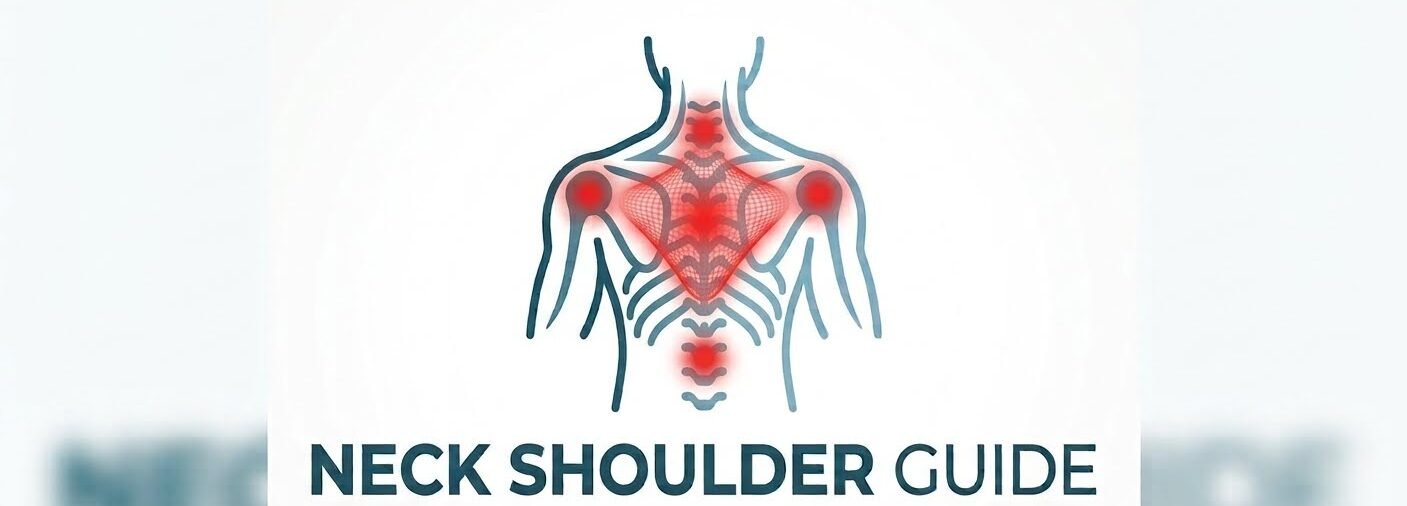
Your shoulder blade (scapula) is a flat, triangular bone that rests on the back of your ribcage. It has no ball-and-socket joint holding it to your spine. About 17 muscles attach to it, and those muscles hold it against the ribs and move it. Underneath sits the upper and mid back (thoracic spine): twelve vertebrae, each joined to a pair of ribs. How well the shoulder blade glides depends on those muscles and on how well the upper back and ribs move beneath it.
This region is the link between the neck above and the shoulder out to the side. Pain felt here can start in the muscles, the rib joints or the spine itself, or it can be referred from the neck. This page explains the parts and how each one tends to show up.
Key takeaways
- The shoulder blade floats on muscle: it glides over the back of the ribs and connects to the skeleton only through the collarbone.
- About 17 muscles attach to the shoulder blade: some hold it steady, some move it, and some move the arm from it.
- The thoracic spine has twelve vertebrae: each pairs with a rib on either side through small joints at the back.
- The upper back is built for stability: the ribcage limits bending, but the region still rotates, which matters for turning and reaching.
- Pain between the shoulder blades often comes from the neck: the lower neck is a common source of pain felt along the inner edge of the shoulder blade.
The shoulder blade
The shoulder blade usually sits over roughly the second to seventh ribs, with its inner edge about 5 to 7 cm (2 to 3 inches) from the spine. Its main landmarks are:
- Inner edge (medial border): the long edge nearest your spine. A common site of the ache people describe as “under my shoulder blade”.
- Upper inner corner (superior angle): where the levator scapulae attaches. Often tender in neck and shoulder pain.
- Bottom tip (inferior angle): the point that sticks out if the blade lifts off the ribs.
- Spine of the scapula: the bony ridge across the back of the blade that ends in the acromion, the roof of the shoulder.
- Socket (glenoid): the shallow socket on the outer corner where the upper arm bone sits.
How the shoulder blade moves
The shoulder blade lifts and drops (shrugging), slides toward and away from the spine, and rotates upward and downward. It also tilts forward and back. When you raise your arm overhead, the shoulder blade rotates upward about 50 to 60 degrees and tips back, so the socket stays under the ball of the shoulder. Two muscle pairs do most of this: the upper and lower trapezius together with the serratus anterior.
When the shoulder blade does not move or sit as expected, it is called scapular dyskinesis. It is common in people with shoulder pain, and also in many people without any pain, so on its own it is not a diagnosis. It matters when it changes how the shoulder joint above it is loaded.
The scapular muscles
- Trapezius: a large diamond-shaped muscle in three parts. The upper part runs to the neck and shrugs. The middle part draws the blades together. The lower part pulls the blade down and helps it rotate upward.
- Serratus anterior: wraps around the side of the ribs and holds the blade flat against the ribcage. Weakness or a problem with its nerve (the long thoracic nerve) lets the inner edge lift away, called winging.
- Rhomboids: run from the lower neck and upper back vertebrae to the inner edge, pulling the blade toward the spine.
- Levator scapulae: runs from the upper neck to the upper inner corner. It links neck movement directly to the shoulder blade.
- Pectoralis minor: runs from the front of the ribs to the coracoid at the front of the shoulder blade. When short, it tips the blade forward.
- Muscles that move the arm from the blade: the four rotator cuff muscles, the deltoid, teres major, the biceps and the long head of the triceps.
The shoulder blade is the platform the arm works from, and the upper back is the floor the platform sits on.
The thoracic spine
The upper and mid back has twelve vertebrae, numbered T1 to T12, running from the base of the neck to the bottom of the ribcage. Seen from the side, it curves gently backward (thoracic kyphosis). A curve of roughly 20 to 45 degrees is generally considered typical in adults, and it tends to increase with age.
Like the neck, each level has a disc at the front and paired facet joints at the back. Disc problems here are much less common than in the neck or low back, because the ribcage limits movement. The thoracic spine does a large share of the body’s trunk rotation, though, and straightening it helps you lift your arms fully overhead.
The rib joints
Each rib connects to the spine at two small joints:
- Costovertebral joint: where the head of the rib meets the side of the vertebral bodies.
- Costotransverse joint: where the rib meets the bony side projection (transverse process) of the vertebra, for ribs 1 to 10.
These joints move a little with every breath. When one is irritated, the pain is usually sharp and one-sided, close to the spine, and it can be worse with a deep breath, a cough, a sneeze or twisting. Pain may also wrap around along the line of the rib. At the front, the upper ribs join the breastbone through cartilage, and irritation there (costochondritis) causes front-of-chest pain that is tender to press.
How the upper back connects to the neck and shoulder
- To the neck: the lowest neck vertebra rests on T1. A stiff upper back makes the lower neck bend more when you look up or down. Neck muscles such as the levator scapulae and upper trapezius pull on the shoulder blade.
- To the shoulder: the socket is part of the shoulder blade. If a rounded upper back tips the blade forward, the space under the roof of the shoulder is used less efficiently when you lift your arm, which is one factor linked to shoulder impingement-type pain.
- To the arm: the T1 nerve root joins the brachial plexus, which supplies the arm.
Which problems start where
- Scapular muscles: upper back strain and muscle ache along the inner edge, often after a new load such as lifting, carrying or long desk hours.
- Lower neck: pain between the shoulder blades or along the inner edge that changes with neck movement. This is a common source and often overlooked.
- Rib joints: sharp one-sided pain near the spine, worse with deep breaths and twisting.
- Thoracic facet joints: local aching and stiffness in the mid back, often worse after sitting.
- Nerves to the shoulder blade: winging from a long thoracic nerve problem, or weakness and ache over the back of the blade from a suprascapular nerve problem.
- Vertebrae: compression fractures, more common with osteoporosis, can cause sudden mid back pain after a minor strain, a fall or even a cough.
What it means for you: rubbing a sore spot by the shoulder blade often brings short relief. If the pain keeps coming back, the source may be the neck or the rib joints rather than the muscle you can feel. Pain that changes as you move your neck points toward the neck. Pain that catches with a deep breath or a twist points toward the rib joints.
Organs can also refer pain here. The heart can refer pain between the shoulder blades or to the left shoulder. The gallbladder can refer pain under the right shoulder blade, often after fatty meals. The lungs and the aorta can refer pain to the upper back.
Get it checked if
- Chest symptoms come with it: upper back pain with chest pain, breathlessness, sweating, nausea or pain spreading to the arm or jaw needs your local emergency number now.
- Sudden severe tearing pain between the shoulder blades: call your local emergency number.
- Pain after a fall, or sudden mid back pain with osteoporosis: see a doctor today.
- Fever, unexplained weight loss or a history of cancer: with constant upper back pain that does not change with position, see a doctor soon.
- Your shoulder blade starts to stick out: new winging, or weakness pushing or reaching forward, is worth having checked.
- Numbness or weakness in the legs, or a change in bladder or bowel control: needs urgent medical assessment.
More on this area: anatomy guides.
The sore spot by your shoulder blade is where you feel it, not always where it starts.
Written by Louise Yow, Neck & Shoulder Physio.